SDVOSB — Service-Disabled Veteran-Owned Small Business Ret. USAF F-15C pilot · 22-year veteran A KBM Solved IT company

Operations control centre

Nexus Dispatch

The flight that is about to break is already on the board. It is just not near the top.

Maturity:Pilot-ready Evidence tier:Demonstrated

Nexus Dispatch is decision support for the operations control centre. It reads the operation the way a dispatcher does — flight by flight, constraint by constraint — and sorts the board by risk instead of departure time, with the drivers behind every score visible. It does not release aircraft. It helps the person who does make a better-informed call, and it writes down what they decided and why.

Status Working demonstration surface over a working engine, running on seeded and public data. No airline is operating it.

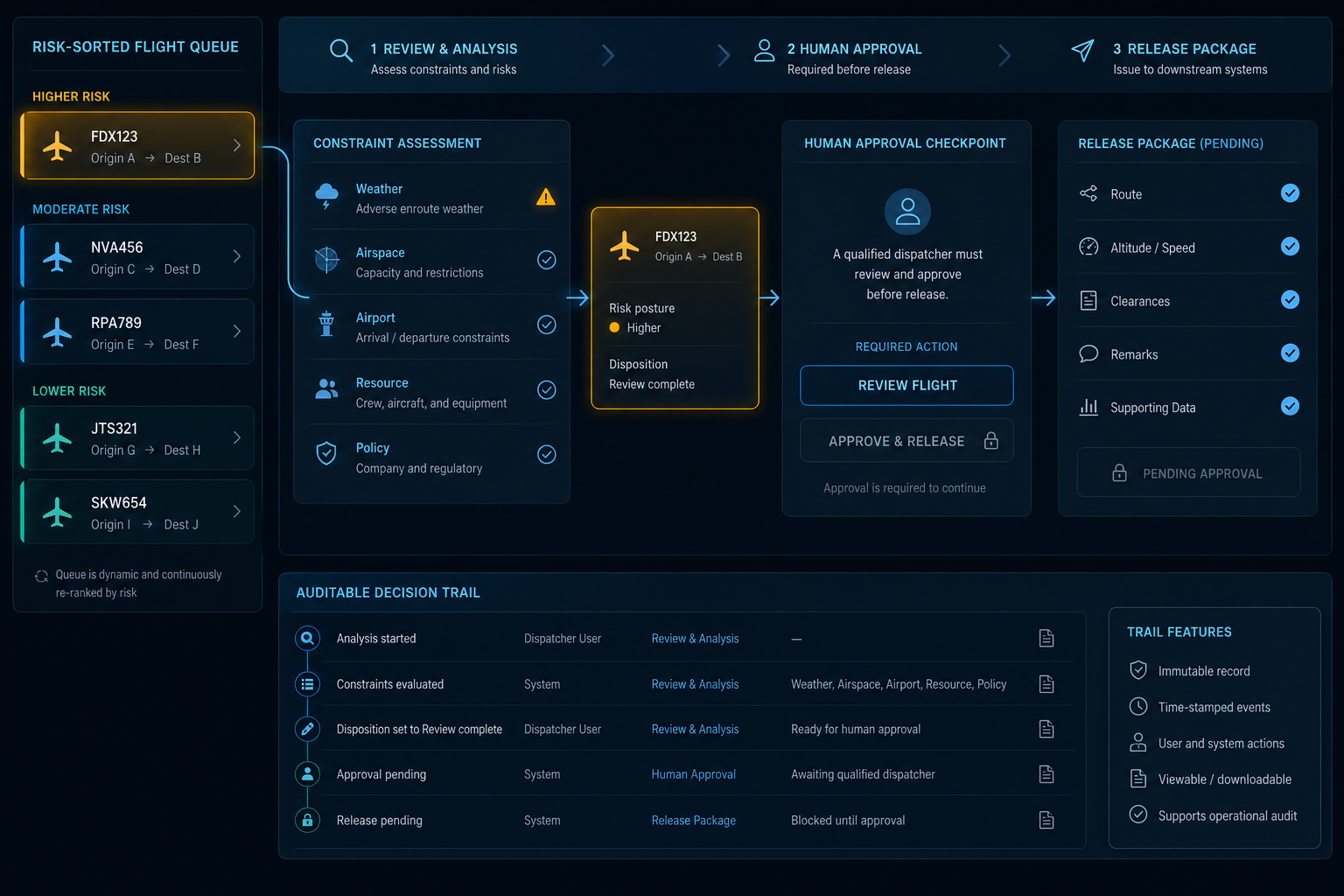
Illustrative risk-sorted flight queue progressing through constraint review and a required human approval checkpoint
Illustrative Guided release lane with qualified-human approval required.

The problem

The board is sorted by time. The risk is not.

A dispatcher working a bank of departures reads four to six systems that do not talk to each other: weather, crew legality, maintenance status, ATC constraints, gate and turn state. Each is authoritative about its own slice and blind to the rest. The flight that is about to break is on the board somewhere — it just is not near the top, because the board is sorted by scheduled departure.

  • Risk lives in the intersection of systems, and no single system owns the intersection.
  • By the time a disruption is visible on a status board, the cheap options have already expired.
  • The reasoning behind a recovery decision usually lives in a phone call and a dispatcher’s memory, not in a record anyone can review later.

The answer

Sort by exposure. Show the drivers. Keep the record.

Nexus Dispatch reads the same operational records the desk already has and re-sorts them by risk, with the reason chips that produced each score attached. When a flight needs a decision, the candidate recoveries are scored side by side against doing nothing, and the dispatcher’s choice — with the person, the time and the reasoning — is appended to a chained record that fails verification if anyone edits it afterwards.

What it does · 5 capabilities

The parts of Nexus Dispatch worth watching

Each capability below exists in the build described on this page. Anything planned rather than present appears under status, not here.

  1. Risk-sorted network board

    Every flight carries a 0–100 operational risk score with reason chips naming what is driving it — weather at destination, crew duty margin, maintenance status, ATC or flow constraints. The board sorts by exposure, so the flight most likely to break is the one you read first.

  2. Flight decision record

    Open any flight and see the risk drivers, the recommendation, the timeline, crew and maintenance state, and passenger impact on one page — with approve, reject and note actions that append to an auditable trail rather than disappearing into a chat window.

  3. Recovery comparison

    Candidate recoveries are scored side by side against the do-nothing baseline on delay minutes, misconnects, crew legality, gate impact, cost and confidence. The comparison is the deliverable — the dispatcher chooses.

  4. Sourced analyst

    Ask the operation a question in plain language and get an answer assembled from the records, with its sources and a confidence note attached. With no model credential configured the analyst still answers, deterministically, from the records alone.

  5. Tamper-evident decision trail

    Advisory decisions are written into a chained record with a keyed signature. The chain verifies in the interface, and a record edited after the fact fails that verification — which is the entire point of having it.

Boundaries

What it will not do, what it touches, and how it fails.

Three questions any operator should ask before an evaluation, answered before you have to ask them.

Human control Where the authority stays

Nexus Dispatch is decision support. It never releases an aircraft, never files or amends a flight plan, and never executes a recovery. Every recommendation requires a qualified human to approve it, and the approval — with the person, the time and the reasoning — is what gets written to the record. Dispatch authority and operational control stay exactly where regulation puts them.

Privacy boundary What it touches

The product reads flight, crew, maintenance and constraint records to score risk. In every current demonstration those records are synthetic; weather and published navigation data come from public services. Nothing is sent to a third party for scoring, nothing is retained for model training, and in an on-premises or controlled deployment the records never leave the operator’s boundary. Crew data is the sensitive part of this product and is treated as such: duty margin is shown as a constraint, not as a personnel file.

Degraded mode When something is unavailable

With no model credential the analyst answers deterministically from records — the normal demonstration configuration. If the public weather service is unreachable, the product falls back to clearly labelled synthetic observations rather than presenting stale data as current. If a record is unavailable, the flight is scored on what is present and the missing input is named rather than silently defaulted.

The same questions answered across the whole portfolio, with dates: trust & safety

Honest status · Pilot-ready

What is built — and what is not.

Working demonstration surface over a working engine, running on seeded and public data. No airline is operating it.

Built and exercisable today

  • A demonstration surface covering the full workflow: network board, per-flight decision record, recovery comparison and analyst, over a seeded fictional carrier.
  • A separate production-intent engine (Python service plus a web client) with route planning over real published navigation fixes, fuel and weight-and-balance validation, and a fleet simulation.
  • Live public aviation weather ingestion — observations, forecasts and significant-weather advisories — with a labelled synthetic fallback when the public service is unreachable.
  • Signed short-lived API tokens, a hash-chained decision log, human-approval gating on every advisory action, and secrets held in environment configuration rather than the repository.
  • A deterministic analyst path that works with no language-model credential present at all.

Not built — named, not hidden

  • No live integration with an airline’s operations, crew, maintenance or reservation systems. The integration seams are built and documented; the integrations are not.
  • No single sign-on, role scoping, retention policy or model-governance programme yet — these are pilot-hardening items, not shipped features.
  • No SOC 2, FedRAMP or any other certification. Both are costed roadmap items and neither programme has started.
  • Gate and turn management, an external communications composer and an integration-health console are specified follow-on work, not present today.

Claims and evidence

Every claim, at the tier its evidence supports.

If a claim below is worded more strongly than its basis justifies, it is a defect and we want to hear about it.

Nexus Dispatch — claims and their basis
Claim Tier Basis
The full dispatcher workflow — risk board, decision record, recovery comparison, analyst — runs end to end and can be exercised in a live session. Evidence tier:Demonstrated Demonstration surface, seeded carrier data.
Route planning uses real published navigation fixes rather than great-circle approximations. Evidence tier:Demonstrated Planning engine over a navigation database of published US fixes.
Weather comes from the public aviation weather service, not a fixture. Evidence tier:Demonstrated Live observation, forecast and advisory ingestion with a labelled synthetic fallback.
A decision record altered after it was written fails chain verification. Evidence tier:Demonstrated Hash-chained audit log with an in-interface verification and tamper test.
Risk scores and recovery costs shown in the demonstration are computed from synthetic fixtures and describe the demonstration, not an airline. Evidence tier:Modeled Seeded scenario data.

Fair questions

What people push back on — and the honest answer

These are the objections this product actually gets. None of them has a clever answer, which is why they are worth printing.

  • We already have a dispatch system. Why would we add another screen?

    You would not — adding a seventh screen to six would be a worse operation, not a better one. The argument for this product is that it consolidates the reading a dispatcher is already doing across systems into one ordering, and produces a record you currently reconstruct by hand. If it does not remove reading, it is not worth the desk space, and that is a fair thing to judge it on in a walkthrough.

  • How do we know the risk score is not just a number the AI made up?

    Because a language model does not produce it. The score is computed by explicit rules over records, the drivers are listed next to it, and the same inputs produce the same score every time. You can disagree with the weighting — and in a pilot you would tune it — but you can always see what produced it.

  • What happens in an audit or a safety review?

    That is the part we would open first. Decisions are chained and signed; the interface verifies the chain and includes a deliberate tamper test that fails on a post-hoc edit. What we do not have yet is SSO, role scoping and a retention policy, and those are named on this page rather than discovered in procurement.

Who buys this

Who Nexus Dispatch is built for

The operators whose problem this product is actually shaped around. Each has its own path from first contact to a decision.

Regional airlines

Scheduled carriers running turboprop and regional-jet fleets, often on capacity-purchase agreements, with a real operations control centre and no eight-figure software budget.

Part 135, charter & fractional

On-demand and fractional operators flying short-notice missions where the schedule is written the night before and rewritten in the morning.

OCC leadership

Directors and vice-presidents of operations accountable for network performance, disruption cost and the answer to what happened this morning.

Next step

Request a dispatch walkthrough

Forty minutes, driven live on seeded data, ending with the risk drivers you would actually want scored in your operation — and what would have to be true to score them.

Request a dispatch walkthrough